Introduction
How csdn-cli is put together.
csdn is a single Go binary built on the any-cli/kit framework. It reads CSDN
(CSDN博客), China's largest developer-blog community, through its public web
surfaces and prints clean structured records you can pipe into your tools. No API
key, no login.
Read operations, three ways
The read operations are defined once and exposed three ways:
- on the CLI, as
csdn hot,csdn search,csdn article,csdn user,csdn posts, andcsdn comments; - over HTTP, with
csdn serve(NDJSON responses; endpoints include/healthzand/v1/openapi.json); - over MCP, with
csdn mcp(an MCP server over stdio).
The same code answers all three, so a record you get on the CLI is the same record you get over HTTP or MCP.
Surfaces
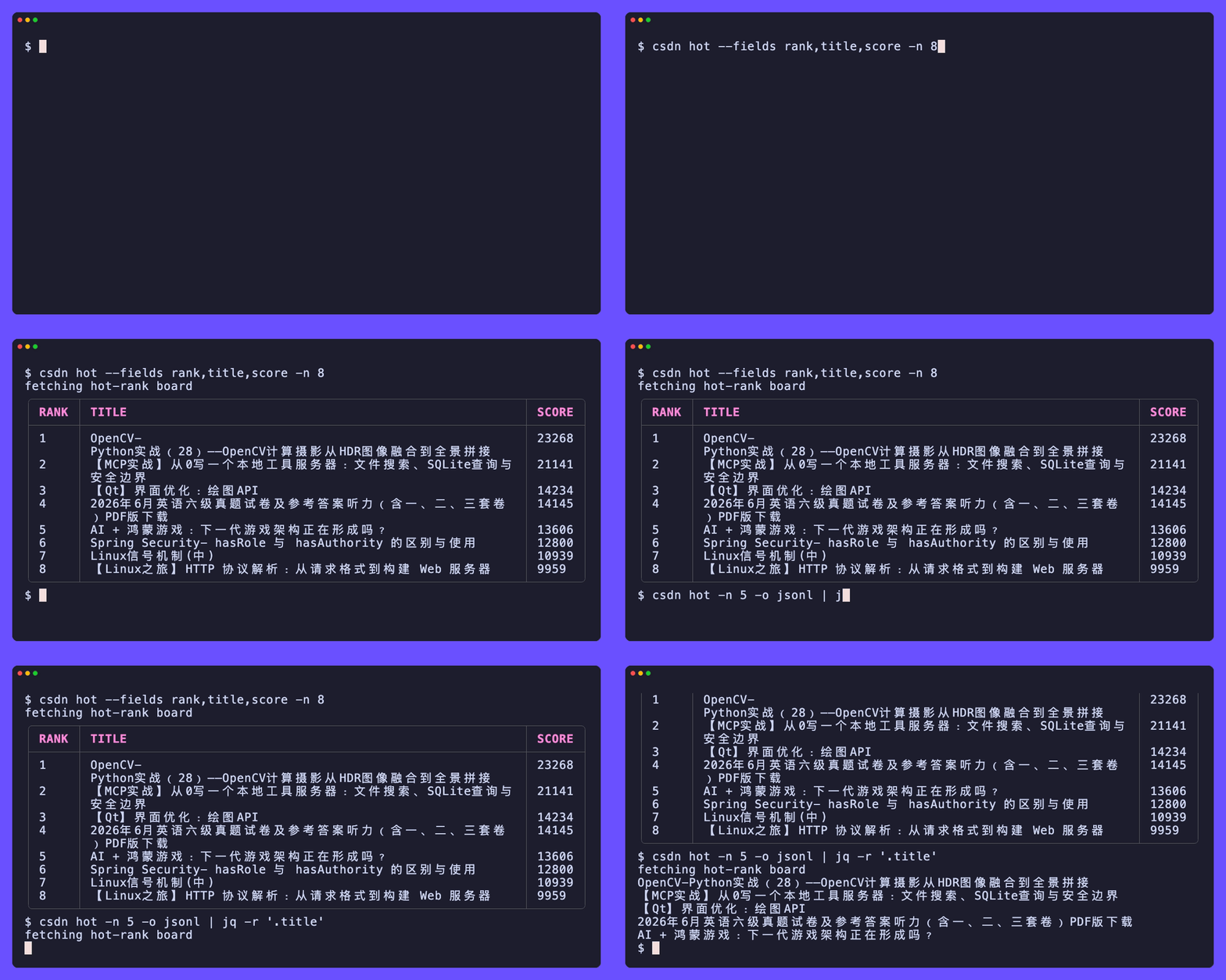
hotreads the CSDN hot-rank board (CSDN热榜), in rank order, as ranked article rows.searchreads blog search hits for a query, with--type blog|all|ask|download|bbs.articlereads one article with its body, parsed from the HTML page and the embedded JSON-LD.userreads a public profile, from the page'swindow.__INITIAL_STATE__blob plus a tab-total JSON for the content counts.postsreads a user's published articles.commentsreads the comment thread under an article.
No signing
This is the one big contrast with the rest of the fleet (douyin, bilibili,
xiaohongshu, and the like), which all carry a reimplemented request signer. CSDN
is open: there is no signature to compute anywhere. Every read surface answers a
plain anonymous GET, as long as the request carries a full browser header set
(a real Chrome User-Agent, Accept-Language: zh-CN, and the Referer each
surface expects). The client builds exactly that and picks the right Referer per
surface, so the request looks like a logged-out browser.
Output
Every read command returns records. At a terminal the default format is a table;
piped, it is JSONL. Pass -o json, -o csv, -o tsv, -o url, -o markdown,
or -o raw to change format explicitly, and --fields or --template to shape
what each record shows.
The one wall
CSDN has no key gate, so the only thing that can stop a request is the anti-bot edge. It scores each caller and, when it decides a request is not a real browser, it fronts one of three blocks:
- a 521 status,
- a 403
cdn_cgi_bs_botchallenge page, - or an HTML challenge shell in place of the page.
The client sends real browser headers and the Referer each surface expects, then on a wall returns a clean exit 4 (needs a residential session). It never crashes and never fakes data. A 521 is retried; a 403 maps straight to walled because the edge engages it per surface after repeated calls from one address.
Live from a datacenter IP, hot, search, article, user, and posts all
returned rich real records. comments was the one surface the bot wall held shut
there (a sticky 403), reported honestly as exit 4. From a normal residential IP,
all six return real data.
Not affiliated
csdn is an independent tool and is not affiliated with, authorized, or endorsed by CSDN (北京创新乐知网络技术有限公司).